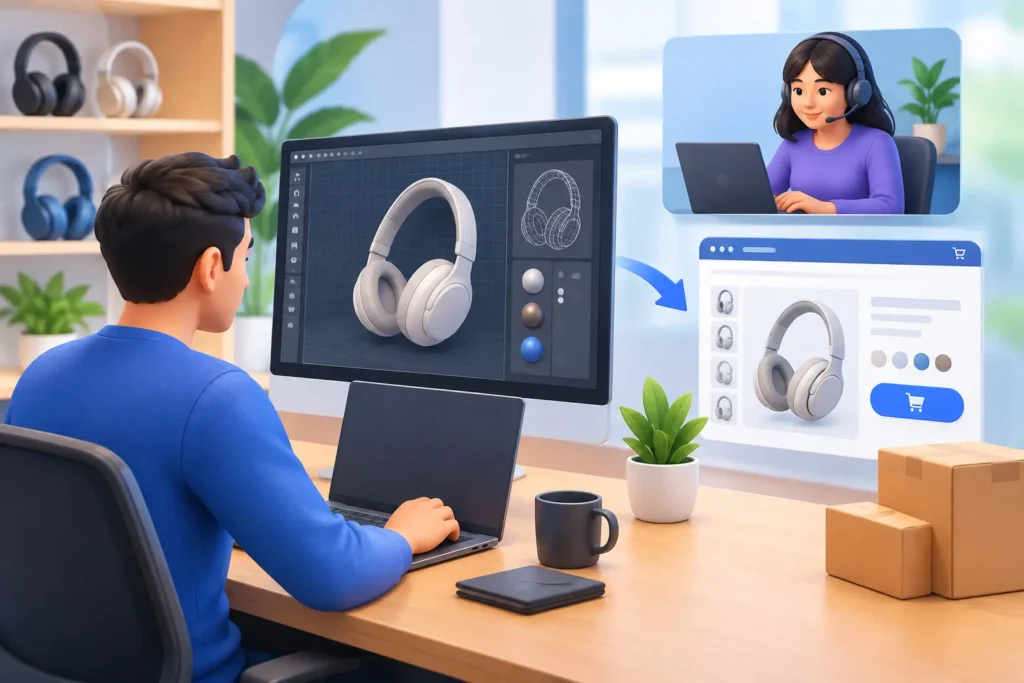

A product launch can no longer wait weeks for a hero image, and an architectural pitch cannot afford visuals that look generic beside a competitor’s interactive walkthrough. The most relevant 3d rendering trends 2026 are responding to that commercial pressure: faster production, greater realism, more versions, and assets that work across campaigns instead of one presentation.
For marketing teams, studios, architects, and product companies, the opportunity is not simply to adopt more technology. It is to build a visual production workflow that protects quality while reducing bottlenecks. The following trends show where rendering is headed and what buyers should ask of an outsourced 3D partner.
1. Real-Time Rendering Moves Into Commercial Production
Real-time engines have long been valuable for previews, games, and virtual production. In 2026, they are becoming a practical choice for approved marketing visuals, architectural experiences, product configurators, and sales tools.
The advantage is speed after the initial scene is built. A team can change a camera angle, switch a finish, adjust lighting, or generate a set of product variations without restarting a long offline render queue. For architecture, this supports live design reviews. For consumer products, it makes regional campaigns and colorway updates more achievable within a fixed schedule.
This does not mean every final asset should be rendered in real time. High-end automotive close-ups, complex transparent materials, medical imagery, and cinematic animation may still require offline rendering for the best light transport, detail, and control. The strongest approach is often hybrid: use real-time tools for iteration and interactive content, then use offline rendering where photorealism carries the sale.
2. AI Speeds Up Decisions, Not Just Image Creation
AI is affecting rendering pipelines most usefully behind the scenes. It can assist with reference gathering, concept exploration, texture generation, masking, denoising, upscaling, and repetitive asset preparation. These applications can reduce time spent on low-value manual tasks and give artists more room to focus on composition, materials, motion, and brand-specific detail.
For commercial buyers, the key question is not whether a vendor uses AI. It is whether the team can maintain control over the result. Product visualization must show correct geometry, approved finishes, and credible proportions. Medical animation must communicate anatomy accurately. Architectural imagery must align with the actual design intent.
AI-generated shortcuts can create errors that are expensive to catch late in production: impossible reflections, incorrect product features, inconsistent labels, or visual details that do not match a CAD source. A capable production team uses AI as an accelerator within a supervised pipeline, not as a substitute for modeling discipline, art direction, and quality assurance.
3. Material Accuracy Becomes a Competitive Advantage
Customers have become more familiar with polished CGI, which means a glossy image alone no longer proves quality. In 2026, the gap between acceptable and convincing rendering will increasingly come down to material behavior.
Metal needs the right edge softness and reflection breakup. Fabric needs believable weave, tension, and response to light. Plastic needs subtle variation rather than a flat computer-generated sheen. Architectural finishes need scale accuracy and appropriate wear, especially in close-up interior visuals.
This trend matters because buyers are evaluating products before physical samples are available. A misleading material render can create false expectations for customers, distributors, investors, or internal stakeholders. Investing in physically based materials, calibrated lighting, and reliable reference review protects the credibility of the entire campaign.
Build a Review Process Around References
The fastest way to improve material accuracy is to provide clear references early: physical samples, finish codes, CAD files, product photography, brand style guides, and notes about what must be emphasized or avoided. An expert 3D team can interpret these inputs, but strong source information prevents unnecessary revision cycles.
4. One 3D Asset Must Deliver Many Outputs
A single approved model is becoming the center of a larger content system. The same product asset may be used for ecommerce images, launch videos, social cutdowns, retail displays, augmented reality, training materials, and internal presentations. The same architectural environment may support still images, animation, VR reviews, and marketing films.
This asset-first mindset changes how projects should be scoped. It is more efficient to plan model topology, UVs, materials, rigging, and naming conventions for reuse from the beginning than to rebuild an object for each channel. It also makes version control more important. Teams need to know which geometry, finishes, labels, and camera packages are approved.
For outsourced production, reusable assets offer a clear financial advantage. The upfront effort may be higher than creating a single still image, but the cost per deliverable decreases when the asset supports an entire campaign. It depends on the expected lifespan of the product and the number of channels involved, but for recurring campaigns, the business case is strong.
5. Product Configurators Demand Better Production Discipline
Customization is no longer limited to large-ticket categories such as vehicles, furniture, and home design. More brands are using interactive configuration to let buyers choose colors, materials, accessories, and layouts before purchase.
Behind a simple interface is a demanding production task. Every variation must use accurate geometry, consistent lighting, optimized textures, and logical rules. A configuration system can fail visually when one option clips through another, a material behaves differently between views, or loading times become too slow for a sales conversation.
The trend is pushing 3D teams to think like both artists and production engineers. Asset optimization, modular modeling, naming conventions, and technical testing are now part of the visual standard. Organizations should involve their 3D partner early, before a configurator platform or user experience is locked, so the asset strategy supports the actual customer journey.
6. Virtual Production Expands Beyond Film Sets
LED volumes and real-time environments are becoming more accessible for advertising, branded content, product films, and corporate video. Rather than relying only on location shoots or green screens, production teams can place talent and products inside controlled digital environments.
The benefit is not just visual spectacle. Virtual production can reduce travel, weather risk, location restrictions, and reshoot costs. It also gives directors more control over time of day, background composition, and product placement while filming.
However, it requires early coordination. Environment modeling, lighting, camera tracking, color management, and on-set technical support must work together. A beautiful background that is not optimized for the volume or does not match the physical foreground will still look artificial. For projects with repeatable environments, complex logistics, or multiple market versions, virtual production can be the best choice. For a simple one-day live-action shoot, traditional methods may remain more economical.
7. Faster Delivery Will Depend on Scalable Teams
The final trend is operational. Demand for high-volume visual content is growing faster than many internal creative departments can hire for. Product launches create sudden peaks. Architecture firms need images at key approval stages. Studios may require specialized modeling, rigging, animation, compositing, or rendering capacity without adding permanent overhead.
This is why flexible outsourced production is becoming central to the 3D rendering market. The right external team can expand capacity quickly while maintaining a clear workflow for briefs, milestones, feedback, approvals, and final delivery. That structure is particularly valuable when projects involve multiple stakeholders across time zones.
Speed should never mean sending work into a black box. Buyers should expect an accountable production process: defined deliverables, technical requirements confirmed at the start, review checkpoints, transparent revision handling, and final files prepared for their intended channel. At 3D Modeling Animation Studio, that combination of specialized talent and production coordination is what turns visual demand into dependable delivery.
What the 3D Rendering Trends in 2026 Mean for Your Next Brief
The best time to address these trends is before the first model is built. Define where the asset will appear, how many variants are required, whether it must be interactive, and what level of realism the audience expects. Then choose a production partner with the tools and process to support those decisions.
A well-planned 3D pipeline does more than produce an attractive image. It gives your team a reliable visual foundation for the next launch, pitch, approval cycle, or campaign deadline.