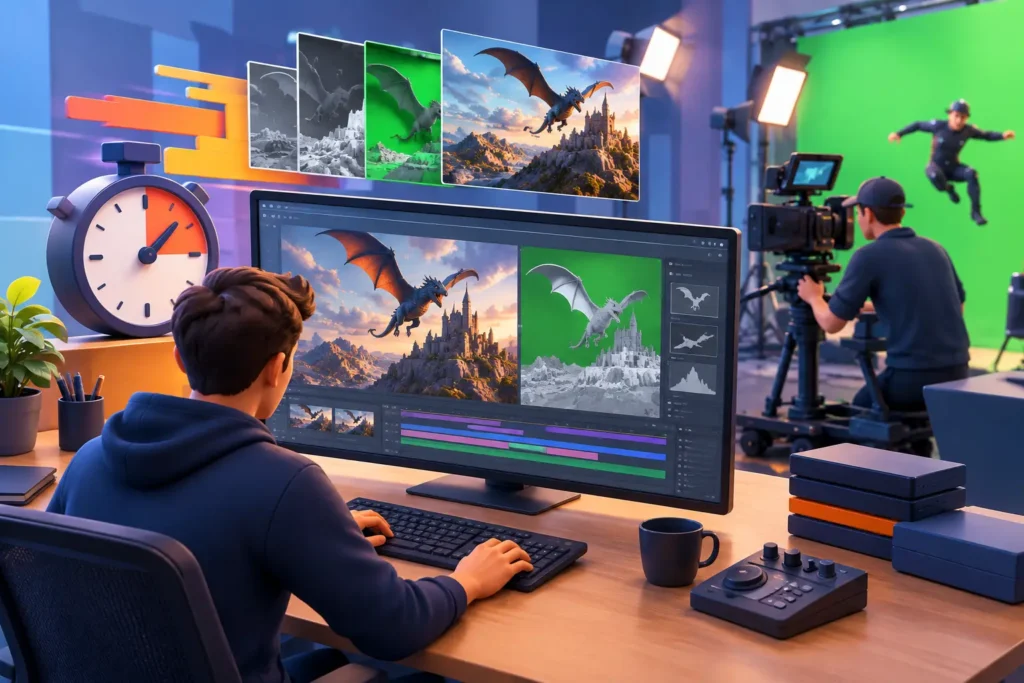

A product launch can lose momentum long before media buying begins. The usual cause is not a weak campaign concept. It is waiting on samples, reshooting photography after a design update, or trying to make one set of images work across ecommerce, sales decks, social media, and retail displays. A capable 3d product visualization company removes that bottleneck by creating accurate, reusable visual assets before physical production is complete.
For marketing leaders, product teams, and creative studios, the question is not whether 3D can create attractive images. The question is whether an external production partner can deliver visuals that are technically correct, commercially useful, and ready when the campaign needs them. The right choice supports faster approvals, protects brand standards, and gives internal teams more room to focus on launch strategy.
What a 3D Product Visualization Company Should Deliver
Product visualization is more than a polished render on a white background. It is a production system for showing a product clearly, consistently, and persuasively in every channel where customers make decisions.
A qualified partner should be able to build precise 3D models from CAD files, engineering drawings, reference photography, or physical samples. From that approved base asset, the team can create still renders, 360-degree views, product animations, exploded views, lifestyle scenes, configurator-ready variations, and close-up material details. This reduces duplicated effort when the same product must appear in multiple formats.
Accuracy is the foundation. A beautiful image can still create expensive problems if a finish is wrong, a control is misplaced, or the proportions do not match the final product. For industries such as medical devices, consumer electronics, furniture, automotive, and industrial equipment, visual precision directly affects stakeholder confidence and customer expectations.
The best production partners also understand commercial context. An ecommerce image needs immediate clarity at a small size. A trade show animation must communicate benefits quickly in a busy environment. A product launch video may need to explain technical features that cannot be filmed easily. Each use case calls for different framing, lighting, pacing, and output specifications.
Start With the Business Outcome, Not the Render Style
Many companies begin by sending a few reference images and asking for a quote. That can work for a simple project, but it often produces unclear scope, inconsistent revisions, and assets that do not serve the full campaign.
Before evaluating vendors, define what the visuals need to accomplish. Are you launching a product that is still in development? Do you need a product family shown in multiple colors and configurations? Are sales teams asking for a technical animation that demonstrates internal components? Will the assets need to work across web, print, paid media, retail, and video?
This level of clarity helps a vendor recommend the right production approach. For example, a single hero image may not require extensive environment modeling. A premium furniture campaign may benefit from a complete lifestyle scene that can generate multiple camera angles. A complex machine may require a carefully planned exploded animation rather than a standard product spin.
There is a trade-off between speed, detail, and flexibility. Highly detailed custom environments and photoreal material development take more production time, but they can create a large library of campaign-ready content. A focused studio setup is faster and more cost-efficient when the goal is a clean catalog or marketplace image. A reliable partner will explain these choices instead of treating every request as the same type of render.
Evaluate Technical Accuracy and Creative Range
A portfolio should show more than attractive final frames. Look for evidence that the team can solve the visual challenges relevant to your product category. Strong examples demonstrate believable materials, clean geometry, consistent lighting, realistic scale, and intentional composition.
Ask how the team handles source files. CAD data is valuable, but it is not automatically ready for rendering. Engineering models often need optimization, cleanup, retopology, or material reconstruction before they can produce efficient, high-quality visuals. The vendor should have a defined process for translating technical information into production-ready 3D assets without losing critical design detail.
Material quality deserves close attention. Metal, glass, fabric, rubber, painted plastic, brushed surfaces, and transparent components each respond to light differently. Poor material work is often what makes a product look generic or computer-generated. A skilled visualization team uses accurate texture maps, surface properties, and lighting setups to make the product feel credible while preserving the intended brand aesthetic.
Creative range matters as well. A company that only produces isolated product renders may not be the best fit if your launch needs animation, environments, post-production, or video editing. Working with one team across these services can improve consistency and reduce handoffs. However, broader capability only adds value if the provider has proven specialists and a clear quality-control process.
Review the Production Workflow Before You Commit
Production reliability is often more valuable than a low initial quote. Visual projects involve feedback, changing product information, brand approvals, and delivery requirements that may evolve during the campaign. Without a structured workflow, small changes can become costly delays.
A professional workflow usually begins with a discovery stage. The team reviews source materials, references, intended deliverables, technical specifications, and timeline requirements. This is where assumptions should be addressed. Is the design final? Which colors and finishes require approval? Will the product be shown in an environment? Are there legal, regulatory, or brand restrictions on what can be depicted?
Next comes modeling and look development, followed by camera, lighting, animation, or scene production. Review stages should be planned at meaningful milestones rather than left until final rendering. Approving the model before extensive scene work begins prevents late-stage corrections that affect every output.
Ask practical questions about revision management. How many revision rounds are included? Who consolidates client feedback? How are priority changes handled when a launch date moves forward? What files will be delivered at the end of the project? Clear answers are a sign that the company manages production as a business-critical service, not a one-off creative exercise.
Choose Scalable Support for Changing Demand
In-house teams are often stretched when multiple launches overlap or when a campaign suddenly expands into additional markets and formats. Outsourcing gives companies access to specialized talent without recruiting for every temporary production peak.
The value of a 3D partner is especially clear when a product line has many variants. Once the approved base model exists, colors, finishes, accessories, labels, and camera angles can often be produced more efficiently than photographing every combination. That does not mean every variation should be created automatically. Prioritize the configurations that support merchandising, customer questions, and sales activity.
Scalability also applies to output types. A campaign may start with web images and later require motion graphics, retail display visuals, or presentation content for distributors. A full-service team can extend existing assets into new deliverables while maintaining visual continuity. This is usually faster than briefing a new supplier for each format.
For global teams, confirm how the vendor manages time zones, file transfers, review cycles, and communication ownership. Fast turnaround is meaningful only when feedback is tracked accurately and the right decision-makers can approve work without confusion.
Compare Quotes by Production Value, Not Just Price
A low quote can be attractive, particularly when budgets are tight. But price comparisons are only useful when scope is comparable. One proposal may include modeling, art direction, revisions, compositing, and multiple exports, while another covers only a basic render.
Request an itemized scope that identifies the number of products, variants, images, scenes, animation duration, revision rounds, and final file formats. Also ask whether the quote includes source asset preparation, post-production, project management, and any rush-delivery requirements. This makes it easier to identify where costs may change later.
Asset ownership and reuse rights should be discussed early. If you expect to use the model for future campaigns, localization, configurators, or product updates, confirm what will be delivered and how future modifications will be handled. A well-built asset library can create long-term savings, but only if it is organized and accessible.
3D Modeling Animation Studio supports this kind of production with custom modeling, animation, environment development, and post-production under one coordinated workflow. For clients managing variable demand, that combination can reduce the friction of moving between product visuals, campaign content, and technical storytelling.
Make the First Project a Practical Test
The first engagement should test more than image quality. Use it to assess communication, technical interpretation, schedule discipline, revision handling, and final delivery. A focused pilot project can reveal whether the team asks useful questions, flags risks early, and turns feedback into precise updates.
Choose a project that represents real business needs, not simply the easiest possible render. A product with a challenging material, several components, or a defined launch deadline will show how the company performs when details matter. If the process is strong, you will have more than a finished image set. You will have a production partner ready to support the next deadline with confidence.