
A static product page has only a few seconds to answer the questions that matter: What is this? How does it work? Why should I trust it? Can animation improve conversions when those answers need more than a product photo and a block of copy? In many cases, yes. Well-planned animation can turn a difficult-to-explain feature, process, or benefit into a clear visual story that moves buyers closer to action.
For marketing teams and production leaders, the goal is not to add motion because it looks impressive. The goal is to reduce uncertainty at the point of decision. Animation earns its place when it helps a prospect understand the offer faster, visualize an outcome, or take the next step with greater confidence.
Can Animation Improve Conversions? Yes, When It Removes Friction
Conversion friction is often an information problem. A buyer may be interested but still unsure how a product fits into their workflow, whether a service solves their specific challenge, or what makes one option different from another. High-quality animation can make those answers immediate.
A 3D product animation, for example, can rotate a technical product, isolate internal components, demonstrate assembly, and show the product in use within 30 seconds. That is more effective than asking a visitor to interpret a dense specification sheet or imagine the product from several flat images. For B2B buyers evaluating complex equipment, software-connected devices, medical products, or architectural concepts, that clarity can be commercially significant.
Motion also directs attention. A short animation can guide viewers toward the feature that matters most, show the sequence of a process, and establish visual hierarchy on a page crowded with competing messages. Used with discipline, it makes the path to understanding shorter.
The important distinction is between animation that supports a buying decision and animation that simply decorates a page. The first improves comprehension. The second may add loading time, distract from a call to action, or make the experience feel less focused.
Where Animation Has the Strongest Conversion Impact
Animation is especially valuable when the product, service, or result is hard to communicate through static content alone. The more a buyer needs to see change, scale, function, or context, the stronger the business case becomes.
Complex Products and Technical Features
Technical products frequently have features that are valuable but visually hidden. Internal mechanisms, material layers, precision engineering, safety systems, and data-driven functions can be difficult to explain with photography. A cutaway animation or exploded-view sequence makes the value visible without overwhelming the viewer with technical language.
This is useful for manufacturers, industrial suppliers, medical companies, and consumer technology brands. Rather than claiming a product is more efficient or reliable, the animation can show why. That proof supports a stronger product story and gives sales teams a visual asset they can use across landing pages, presentations, trade shows, and outreach.
Products That Need Context
A product image may show what an item looks like, but it does not always show its real-world impact. Animation can place the product in the environment where it is used, demonstrate its scale, and show the before-and-after result.
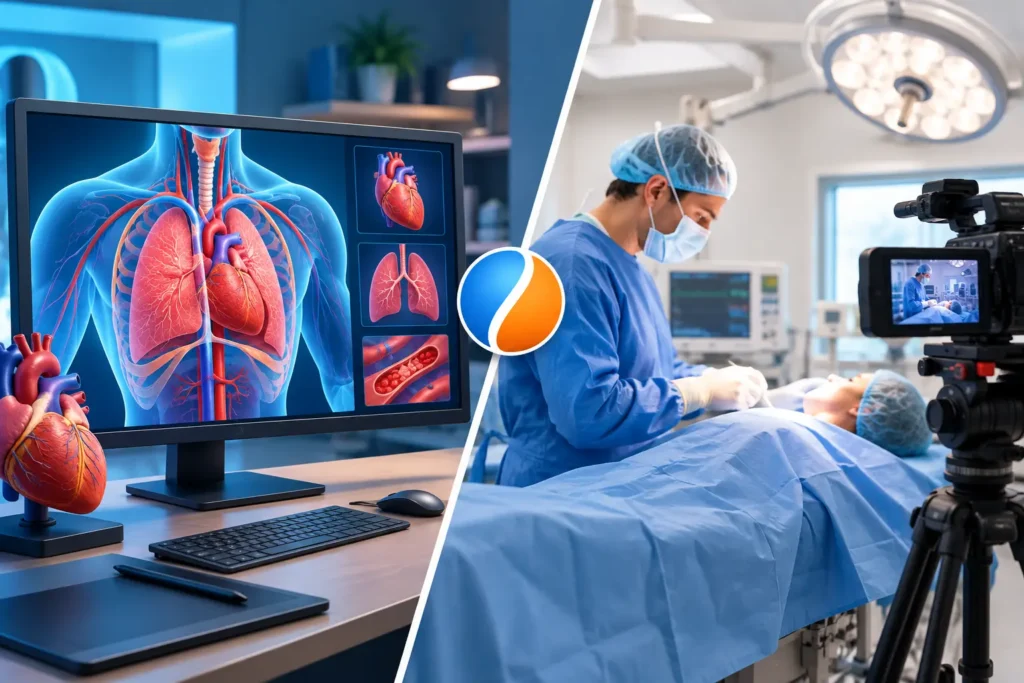
For example, an architectural animation can walk investors through an unbuilt space before construction begins. A furniture brand can show how a modular design changes to fit different rooms. A medical animation can show how a device supports a procedure in a way that is accurate, controlled, and easier to understand than live footage. Context helps buyers connect features to outcomes.
Services With an Invisible Process
Service businesses often face a different challenge. Their deliverable may be valuable but difficult to picture before engagement. Animated explainers can show how a workflow operates, where a client receives support, and what happens after a project begins.
For outsourced production services, animation can clarify the process from briefing and asset handoff through modeling, revisions, rendering, and final delivery. That transparency does not replace a sales conversation, but it can build trust before one occurs. Buyers want to know that a partner has a reliable process, technical control, and the capacity to meet deadlines.
The Psychology Behind Motion and Buyer Confidence
Buyers are more likely to act when they can process information quickly and feel confident in what comes next. Animation can support both outcomes when it has a clear narrative structure.
First, motion can improve recall. A concise visual sequence that shows a problem, a product interaction, and a result is easier to remember than an isolated claim. Second, animation can demonstrate causality. It shows that pressing this control produces that result, or that using this product solves that operational issue. This is particularly persuasive when the benefit cannot be understood from appearance alone.
Third, professional animation signals investment and capability. It is not a substitute for a good product or a credible offer, but visual quality influences perceived quality. In competitive categories, a precise, polished animation can make a brand appear more prepared, technically capable, and trustworthy.
That said, perception only helps when the production quality matches the audience. A low-resolution render, inaccurate product detail, unrealistic movement, or poorly paced script can create the opposite effect. For high-value products and specialized industries, technical precision is part of the conversion strategy.
Animation Must Support the Page, Not Take It Over
The strongest conversion assets are designed around a specific stage of the buyer journey. An attention-grabbing homepage hero may need a short, muted loop that establishes the product and its primary value. A product detail page may need a more deliberate interactive 3D sequence. A paid campaign may perform better with a concise video that reaches the key benefit before the viewer scrolls away.
Length matters. Most conversion-focused animations should get to the point quickly. If the viewer has not understood the central benefit in the opening moments, the content is likely too slow or too broad. Longer animations can work for sales enablement, product launches, training, or detailed case studies, where the audience has already shown deeper interest.
Placement matters as well. Do not bury the animation where few visitors will see it, but do not force it to compete with every message on the page. Pair it with clear supporting copy and a direct call to action. The animation explains and persuades; the page must still make the next action obvious.
Performance cannot be ignored. Large video files, auto-playing audio, and slow page loads can hurt the same conversion rate the asset was meant to improve. A production plan should account for web-ready formats, responsive behavior, compression, and a usable fallback image for visitors with constrained bandwidth.
How to Build Animation for Measurable Results
Start with one conversion question, not a general request for a promotional video. The question could be: Are prospects abandoning the page because they do not understand installation? Do buyers need proof that the product fits into a specific environment? Are sales teams repeatedly explaining the same technical function? A focused problem produces a focused asset.
Next, define the action you want to influence. This may be a quote request, demo booking, product configuration, add-to-cart action, consultation inquiry, or download. The animation should reinforce that action by resolving the objection immediately before it.
A capable 3D production partner will then translate that commercial objective into a storyboard, visual style, asset plan, and production schedule. This is where outsourcing can be a practical advantage. An expert external team can provide modeling, texturing, rigging, animation, rendering, compositing, and editing without requiring a company to build a full internal production department for a single campaign or fluctuating demand.
Finally, measure the asset against a meaningful baseline. Compare engagement, scroll depth, click-through rate, time on page, form submissions, or completed purchases before and after deployment. If possible, test an animated version against a static alternative. Results can vary by audience, traffic source, page speed, and purchase complexity, so assumptions should be tested rather than treated as universal.
Common Mistakes That Limit Conversion Gains
The first mistake is leading with visual spectacle instead of the buyer’s problem. Beautiful animation has limited commercial value if viewers cannot identify what they are looking at or why it matters.
The second is trying to communicate every feature in one asset. When a product has multiple buyer segments, it may be more effective to create several focused animations than one long video attempting to serve everyone. A procurement manager, end user, and technical evaluator may each need a different proof point.
The third is treating the final render as the entire project. Script development, storyboarding, accurate source materials, review stages, and delivery specifications all affect whether the final animation performs. Clear approvals and a defined feedback process protect timelines and keep the message consistent.
Animation works best when it gives a serious buyer one less reason to hesitate. Start with the moment where your current page, presentation, or campaign asks prospects to imagine too much, then show them the answer with precision.