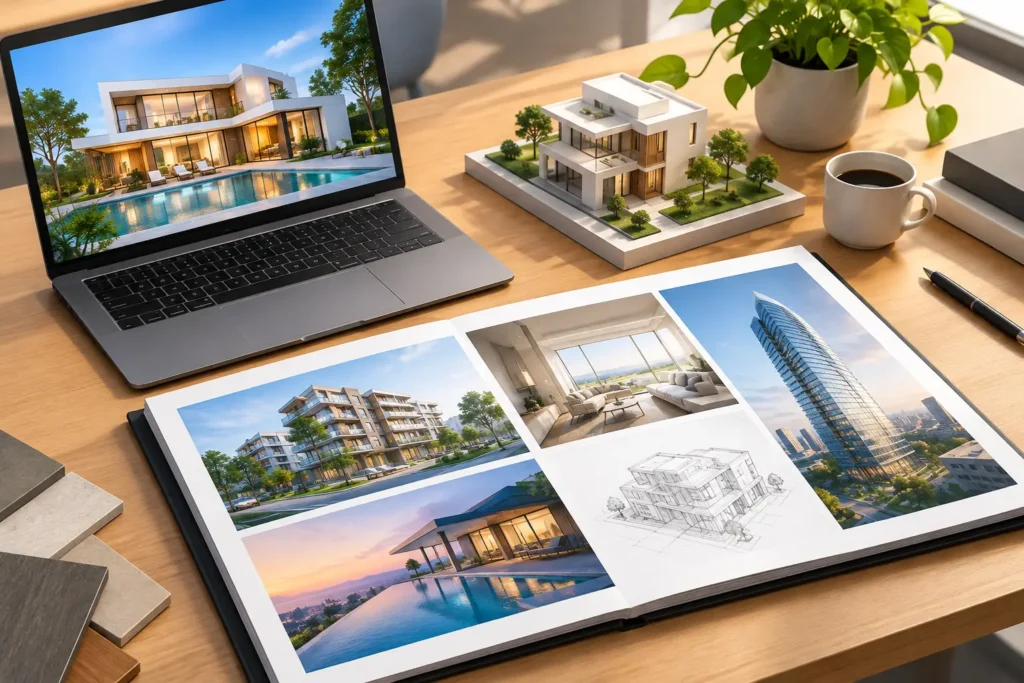
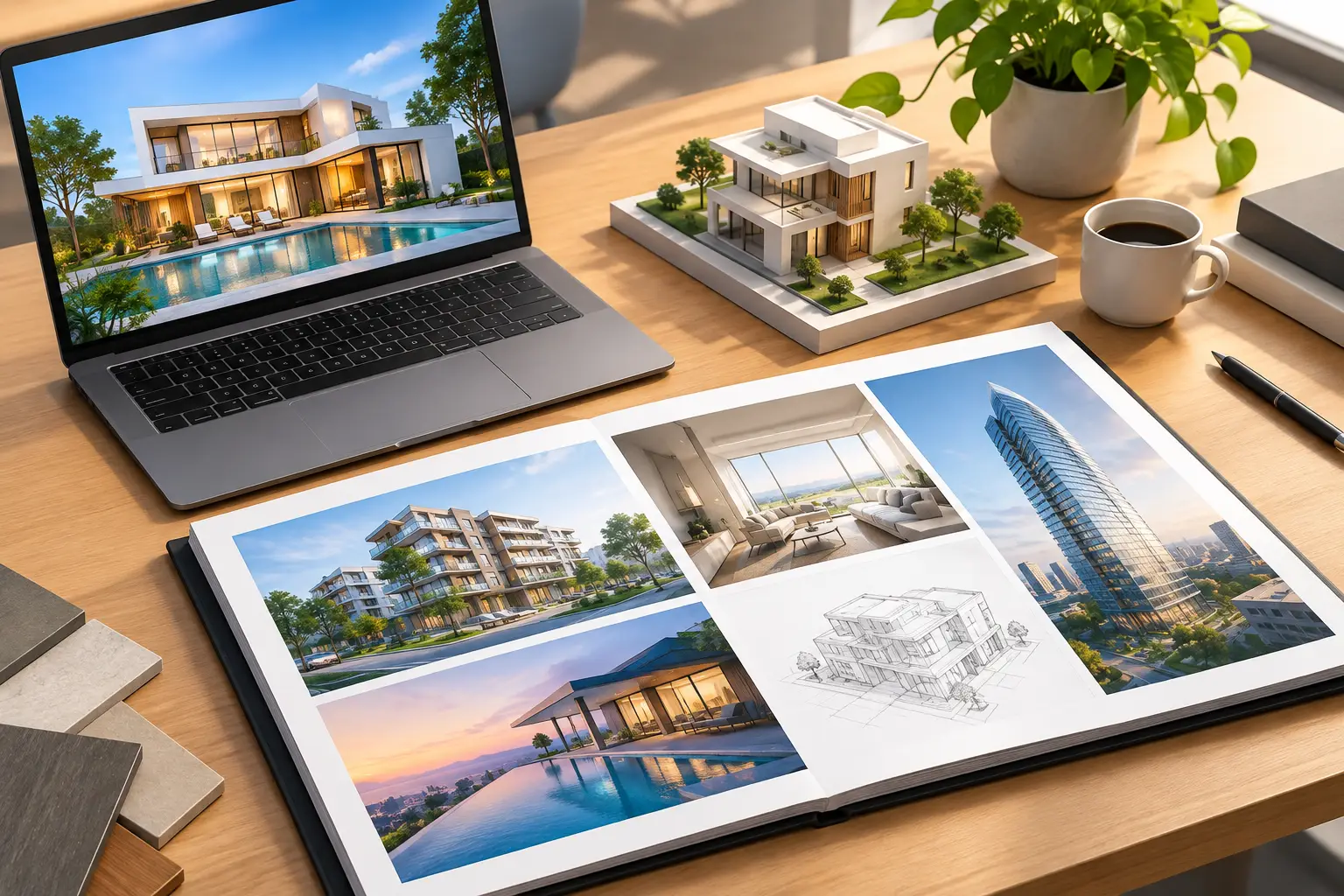
A rendering portfolio is not a gallery of attractive images. For a developer, architect, marketing team, or production partner, it is evidence of whether a visualization team can interpret drawings, protect design intent, and deliver under a real project schedule. The best architectural rendering portfolio examples make that evidence easy to assess.
A polished hero image still matters, but it should not be the only thing you review. Look for a portfolio that demonstrates control across project types, camera language, materials, lighting, context, and post-production. More importantly, look for signs that the work was created for a commercial purpose: leasing, approvals, investor presentations, design reviews, or pre-construction marketing.
What Strong Architectural Rendering Portfolio Examples Show
The strongest portfolios communicate more than visual taste. They show that the artist or studio understands what a project needs to accomplish. A luxury residence may require atmosphere and material detail, while a mixed-use development needs clear massing, street activation, and an accurate sense of scale. Neither approach is automatically better. The right approach depends on the audience and the decision the image needs to support.
A capable partner also shows consistency. If every image has a different visual standard, it can be difficult to predict the result of a larger campaign. Review whether exposure, composition, landscaping, people, and material quality remain controlled from image to image. Consistency is often a better indicator of production reliability than one exceptional render.
10 Portfolio Examples Worth Reviewing
1. Exterior Hero Rendering for a Residential Project
An exterior hero view is often the lead image for a multifamily, custom home, or residential community campaign. It should establish architecture, landscape, weather, and lifestyle in one frame. The building must remain the focus, but the setting should make the project feel believable rather than isolated.
When reviewing this work, check window reflections, facade material transitions, vegetation scale, and the relationship between the building and street. A dramatic sunset can create impact, but it can also conceal unresolved geometry or weak materials. Ask to see daylight views too when architectural accuracy is a priority.
2. Street-Level Mixed-Use Visualization
Street-level images test whether a team understands urban context. They typically include storefronts, pedestrians, street furniture, vehicles, neighboring buildings, and signage. This is where a render moves beyond a model and becomes a persuasive account of how a place will function.
Good examples use people and activity with restraint. Crowded scenes can suggest energy, but excessive figures may distract from circulation, tenant frontage, or architecture. For entitlement and stakeholder presentations, a cleaner view may communicate more effectively than a highly cinematic one.
3. Interior Rendering That Supports a Sales Story
Interior rendering should do more than display furniture. It should show how light enters the room, how circulation works, and which design features justify the value proposition. A kitchen may highlight finishes and appliances; a hospitality lobby may emphasize arrival, atmosphere, and material quality.
Review the details that are easy to overlook: correct furniture proportions, believable fabric and wood textures, contact shadows, and accurate light behavior. These details influence credibility. A beautifully styled interior with distorted scale can undermine a buyer’s confidence quickly.
4. Aerial Rendering for Site and Master Plan Context
Aerial visuals are especially valuable for master-planned communities, resorts, campuses, and large commercial developments. They explain access, open space, amenity locations, building placement, and the relationship to the surrounding area. The strongest examples balance broad planning information with a level of detail that still feels visually compelling.
This format requires a different skill set from a close-up facade render. It may involve terrain modeling, GIS or survey data, extensive landscaping, surrounding context, and careful image compositing. Look for accurate road networks and site boundaries. An aerial image can look impressive while still misrepresenting proximity, orientation, or scale.
5. Design Option Comparisons
A portfolio with before-and-after views or side-by-side design options reveals a practical production mindset. It shows that the team can support the iterative reality of architecture instead of only delivering a final beauty shot. This is useful when design teams need to compare facade systems, amenity layouts, lighting approaches, or landscape strategies.
The visual standard should remain consistent across every option. If one version has better weather, camera placement, or post-production, the comparison becomes biased. Neutral, controlled presentation is often more valuable than maximum visual drama during design decision-making.
6. Material-Focused Detail Views
Close-up views of entries, facades, kitchens, bathrooms, or amenity spaces demonstrate technical attention. They are particularly useful for high-end residential, retail, hospitality, and product-driven architectural projects where material selection drives perceived quality.
A strong detail image shows how materials meet: metal against stone, glazing within a frame, wood beside plaster, or tile around fixtures. Repeating textures, flat reflections, and sharp edges everywhere are warning signs. Physical materials have variation, thickness, and subtle imperfections, and a skilled rendering team knows how to represent them without making the scene look worn or neglected.
7. Night and Dusk Renderings
Dusk images are common in architectural marketing because they create warmth and visual contrast. Interior lighting, illuminated signage, pool reflections, and city lights can make a project feel aspirational. They are effective for hospitality, multifamily, retail, and entertainment spaces.
However, dusk rendering is not a substitute for daylight documentation. Night scenes can hide underdeveloped landscape, incomplete facade modeling, and poor context integration. A reliable portfolio includes dusk images as part of a broader set, not as the entire proof of capability.
8. Unbuilt Context and Future Development Scenes
Many developments are marketed before surrounding parcels, streetscapes, or public amenities are complete. Portfolio work in this category shows how a studio handles informed assumptions. The team may need to model future phases, blend existing photography with proposed construction, or create a context that communicates vision while remaining responsible about what is confirmed.
This work calls for clear coordination. The rendering team should know which elements are approved, conceptual, or subject to change. For business buyers, this is a major production consideration because late-stage changes to context can affect multiple images and budgets.
9. Renovation and Adaptive Reuse Visuals
Renovation projects present a distinct challenge: the proposed design must sit convincingly within an existing structure or neighborhood. Portfolio examples may include photo-matched views, preserved facades, renovated lobbies, industrial conversions, or historic buildings with contemporary additions.
Evaluate how well the proposed work integrates with the existing image or model. Perspective matching, lighting direction, weather conditions, and surface aging all matter. Poor integration can make even a strong concept look artificial, especially when stakeholders know the existing building well.
10. Animation-Ready Architectural Work
Still images demonstrate composition. Animation-ready work demonstrates whether the underlying assets can survive movement, multiple camera angles, and close inspection. For launch films, investor presentations, virtual tours, or social content, this distinction matters.
Look for evidence of coherent modeling across the full environment, not just the visible camera angle. Clean geometry, organized materials, efficient scene construction, and planned lighting help a project move from still renderings into animation without rebuilding everything. This can reduce duplicated effort when a campaign requires both images and video.
How to Review a Portfolio Beyond the Final Image
Ask what the studio received at the start of each project. A compelling render based on complete BIM files, surveyed context, finish schedules, and art direction is different from one built from early plans and limited references. Both can be valuable, but they require different timelines, assumptions, and budgets.
Also ask how revisions were managed. Architectural visualization is rarely a one-pass process. Design updates, client feedback, leasing requirements, and brand changes can all affect the work. A production partner should be able to explain how it tracks comments, confirms priorities, protects deadlines, and identifies changes that affect scope.
For outsourced production, communication is as important as artistic capability. The right team can receive drawings and references, clarify missing information early, share review milestones, and scale output when a project expands from a few images into a full marketing package. At 3D Modeling Animation Studio, that production discipline supports architectural visuals built for both presentation quality and dependable delivery.
Choose Work That Matches Your Actual Project
Do not hire solely based on the most dramatic image in a portfolio. Choose examples that resemble your building type, available source material, audience, and required deliverables. A studio that excels at serene residential interiors may still need a different workflow for a dense urban master plan, a retail rollout, or an animation campaign.
The most useful portfolio should leave you with specific confidence: this team understands projects like yours, can explain its process, and can turn your design information into visuals that move the next decision forward. Bring a clear brief, identify the images that matter most, and use the portfolio review to start a production conversation grounded in outcomes rather than aesthetics alone.