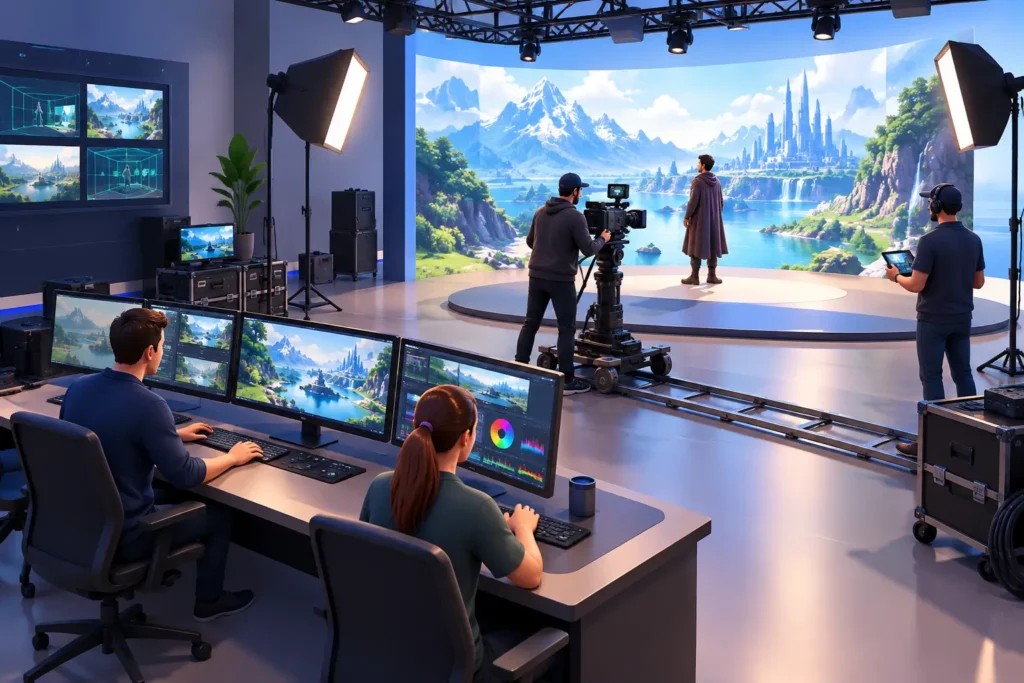
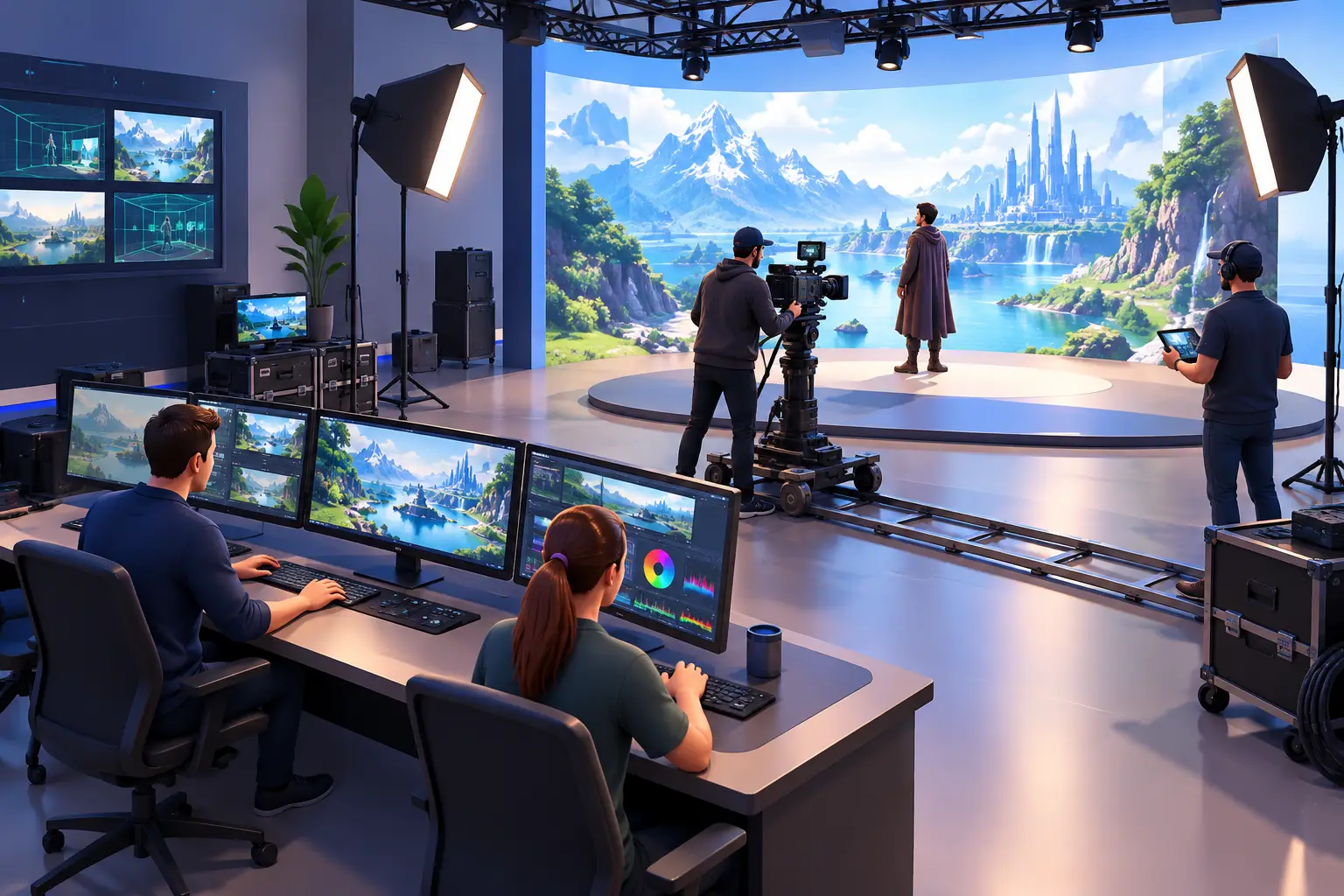
A location change used to mean a new travel schedule, permits, weather risk, freight, and a larger contingency budget. Now, a product launch can place talent inside a photoreal automotive showroom, a futuristic city, or a custom-built medical environment without leaving the stage. Virtual production trends are reshaping that decision-making process by bringing real-time 3D environments, camera tracking, and production planning much closer together.
For brands, agencies, production houses, and studios, the opportunity is not simply to make content look more advanced. It is to produce more controlled visuals, respond to feedback earlier, and scale complex creative ideas without automatically scaling location costs and crew demands. The value is significant, but only when the workflow is planned with the same discipline as any major production.
Virtual Production Trends Changing Production Planning
Virtual production combines real-time game-engine environments, LED volumes or green-screen stages, tracked cameras, 3D assets, and conventional filmmaking. The result can range from in-camera final pixels captured on an LED wall to a hybrid workflow where the virtual set guides the shoot and visual effects are finalized later.
The most important shift is happening before the shoot. Creative teams are using previsualization to make production decisions while scenes are still inexpensive to adjust. A director can review lenses, blocking, lighting direction, and set scale in a virtual space before crew members arrive on set. A marketing team can approve product placement, brand colors, and campaign compositions before physical builds or extensive post-production begin.
This changes the role of 3D from a downstream finishing service into a core planning resource. When environments, products, and props are built accurately from the start, they can support previsualization, virtual scouting, live stage backgrounds, social cutdowns, and future campaign variants. The asset has a longer commercial life than a single shot.
LED volumes are becoming more selective
Large LED stages remain one of the most visible virtual production developments, especially for automotive content, premium commercials, film, and television. They provide interactive light on talent and physical objects, natural reflections on glossy surfaces, and an immediate view of the intended environment through the camera.
However, the trend is not that every production needs an LED volume. These stages require specialized technical setup, careful content preparation, camera tracking, color calibration, and stage time. For a short product film, a green-screen workflow or a fully animated production may offer better cost control. For scenes that depend on accurate reflections, changing outdoor conditions, or extensive interaction between a subject and the background, an LED volume can justify its premium.
The best choice depends on the visual requirement, the shooting ratio, the number of final deliverables, and how much flexibility the project needs after filming.
Real-time rendering is moving into the approval process
Traditional rendering pipelines often ask stakeholders to wait for test frames before judging a scene. Real-time engines reduce that delay. Creative leads can review alternate environments, materials, lighting conditions, and camera angles during a working session rather than through repeated rounds of static approvals.
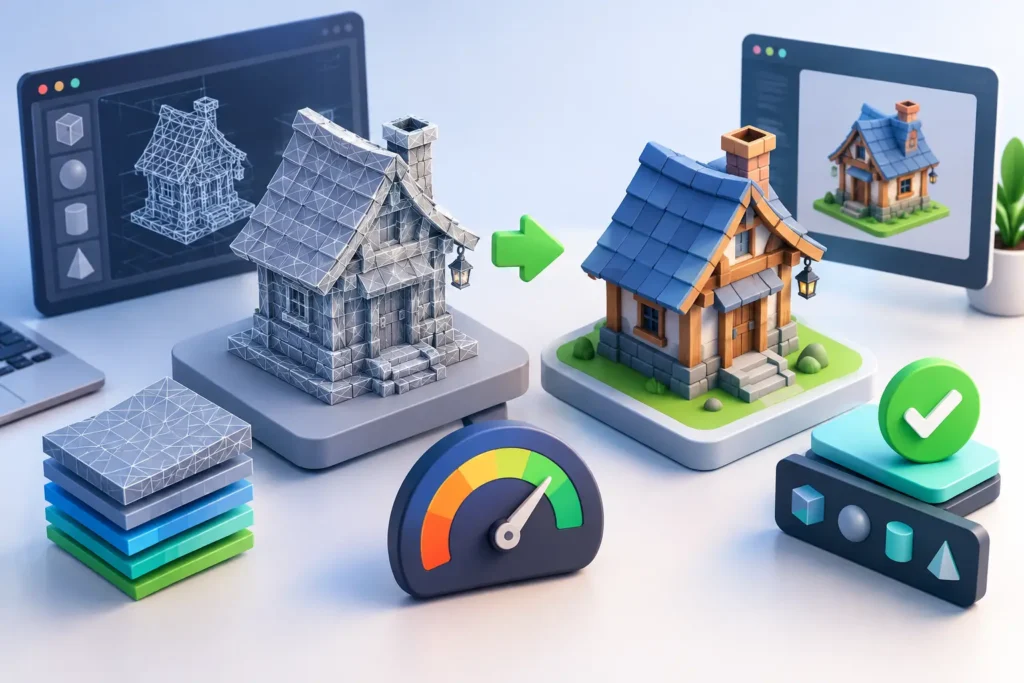
Speed does not eliminate the need for quality control. Real-time scenes still need optimized models, clean textures, correct scale, disciplined lighting, and reliable scene organization. But faster visual feedback helps teams identify issues that are expensive to fix late, such as an environment that distracts from the product or a camera move that weakens the message.
For outsourced production teams, this also creates a more transparent collaboration model. Clients can see how an environment is developing, make informed decisions, and reserve final rendering effort for approved creative directions.
The 3D Asset Pipeline Matters More Than the Stage
A virtual production stage is only as effective as the content prepared for it. Brands often focus on the LED wall or the real-time software because those elements are visible on set. In practice, the production pipeline determines whether the stage delivers efficiency or creates last-minute technical problems.
Assets must be designed for their intended use. A high-detail product model for a close-up commercial may need accurate geometry, physically credible materials, and carefully managed reflections. A large virtual landscape needs smart optimization so it performs at the required frame rate without looking repetitive or artificial. Character animation needs rigs that respond predictably during layout changes and camera revisions.
This is why environment modeling, asset optimization, look development, animation, and post-production should not be treated as separate handoffs. They affect one another. A detailed environment with poor optimization can limit camera options. A product model built without consideration for virtual lighting can create misleading highlights. A late material change can affect every approved shot.
Digital twins are expanding beyond product launches
One of the strongest commercial uses of virtual production is the digital twin: a precise 3D representation of a product, space, or system. Manufacturers can use the same core model for launch films, product configurators, training modules, sales presentations, and technical animations.
For architecture and real estate, accurate digital environments can support design reviews, pre-construction visualization, and cinematic marketing content. For medical and industrial sectors, they can illustrate complex processes that are difficult, unsafe, or impossible to film conventionally.
The key is accuracy. If the 3D model will influence customer expectations, technical training, or stakeholder decisions, dimensions, components, materials, and motion must be verified. Visual polish matters, but precision protects the credibility of the content.
AI Is Accelerating Iteration, Not Replacing Production Expertise
Generative AI tools are influencing concept development, texture exploration, reference gathering, rotoscoping, cleanup, and certain repetitive post-production tasks. Their practical role in virtual production is to reduce time spent on exploratory or administrative work, allowing skilled artists and supervisors to focus on decisions that affect the final image.
For example, AI can help a team explore broad mood directions before building an environment. It can support fast variations for internal discussion. But it does not remove the need for original art direction, production-ready topology, consistent asset libraries, controlled color pipelines, or legal clarity around generated material.
Business buyers should be cautious about treating AI-generated images as finished virtual production assets. A concept image may suggest a direction, but it rarely contains the structured geometry, mapped textures, lighting logic, or animation readiness required for a real-time scene. The commercial result still depends on experienced 3D artists, technical directors, compositors, and production managers.
Hybrid Workflows Will Remain the Practical Standard
The most effective productions are rarely fully virtual or fully physical. They combine the strengths of each approach. A physical foreground set can give performers reliable interaction points and give products authentic contact shadows. A virtual background can extend the location, change the season, or place the action in a setting that would be impractical to build.
Hybrid production also gives brands more options for versioning. A campaign can use the same talent footage while changing virtual environments for different regions, product lines, or audience segments. This is especially useful when a core creative idea needs multiple formats, aspect ratios, and launch dates.
There is a trade-off. More reusable options require more planning at the beginning. Teams need to decide which surfaces, camera angles, and props will remain fixed, which will change later, and what technical standards every deliverable must meet. Without this scope definition, flexibility can turn into uncontrolled revision cycles.
What Clients Should Ask Before Starting
Before approving a virtual production project, decision-makers should establish the creative purpose and the operational requirements together. The first question is not, “Do we need an LED wall?” It is, “What must the audience believe, understand, or do after seeing this content?” That answer guides the right format.
It is also useful to confirm whether assets will be reused, who owns approved source files, what level of realism is required, and how feedback will be managed. A clear schedule should include time for asset creation, technical testing, previs review, the shoot or animation phase, and final post-production. Fast turnaround is achievable when approvals, reference materials, and technical specifications are available early.
A capable outsourced partner can provide the specialized capacity that many internal teams lack: environment artists, modelers, riggers, animators, real-time technicians, editors, and compositors working within one production plan. 3D Modeling Animation Studio supports this approach by building custom assets and visual content around practical production goals, not a one-size-fits-all technology package.
Virtual production will continue to reward companies that treat it as a planning advantage rather than a visual novelty. Start with the message, build assets that can serve more than one deliverable, and choose the production method that gives your team the best balance of control, quality, and speed.