
A medical animation can make a complex mechanism understandable in 60 seconds, or create weeks of rework if its science, scope, and review process are not aligned. Knowing how to choose medical animation is therefore not just a creative decision. It is a production, regulatory, and commercial decision that affects launch timelines, stakeholder confidence, and the credibility of your message.
Whether you need a mechanism of action video, a surgical procedure visualization, a patient education asset, or a medical device demonstration, the right production partner should turn clinical detail into clear visual communication without simplifying the science beyond recognition.
Start With the Decision the Animation Must Support
The strongest medical animations begin with a defined business purpose, not a request for “a high-quality 3D video.” Ask what a viewer needs to understand, believe, or do after watching. A pharmaceutical brand may need to explain how a therapy acts at the cellular level. A device company may need to show correct use, differentiate a technical feature, or support a sales conversation. A hospital or healthcare organization may need to reduce patient anxiety before a procedure.
That objective determines almost every production decision: audience knowledge, level of scientific detail, runtime, visual style, narration, and distribution channel. An animation made for a specialist audience can use precise anatomical terminology and molecular detail. The same subject for patients may need a more guided story, restrained terminology, and visual cues that establish context before explaining the intervention.
Be specific about where the asset will be used. A conference booth loop, a sales presentation, a website hero video, a social cutdown, and a medical education module have different pacing and format requirements. Building these versions into the plan early is more efficient than trying to reshape a master animation after final delivery.
How to Choose Medical Animation With Scientific Accuracy
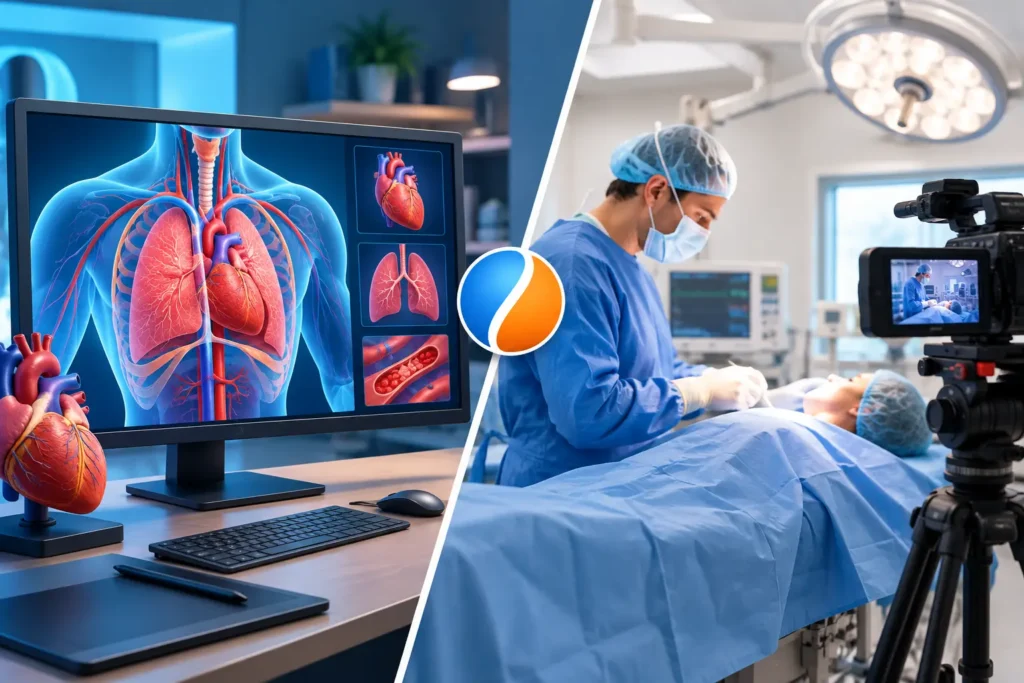
Visual polish matters, but medical accuracy is non-negotiable. Review a prospective studio’s relevant work for more than cinematic lighting or smooth motion. Look for evidence that the team understands anatomical relationships, pathology, medical-device mechanics, biological processes, and the conventions used in clinical communication.
A capable team should be able to explain how it handles source material. In most projects, this includes peer-reviewed literature, approved product information, clinical references, technical drawings, brand materials, and input from subject matter experts. The studio does not replace your medical, legal, or regulatory reviewers. Its job is to create a workflow that gives those reviewers clear opportunities to validate the visual narrative before expensive production work is finalized.
Ask how accuracy is managed at each stage. A written script and storyboard should be approved before detailed modeling and animation begin. For a mechanism of action project, this may include decisions about receptor binding, cellular pathways, biological scale, and which steps need to be shown or omitted. For a device animation, it may include exact component geometry, interaction points, operating sequences, and safety-critical steps.
Be cautious of partners who promise a fast final video without discussing scientific review. Speed is valuable, but uncontrolled speed often shifts problems downstream, where changes cost more and deadlines become harder to protect.
Review the Storyboard, Not Only the Showreel
A showreel shows finishing quality. A storyboard reveals production discipline. Request an example of how the studio translates a technical brief into scenes, annotations, camera direction, and review checkpoints. You want to see a logical path from claim to visual evidence.
This matters because a beautiful animation can still fail if it overstates an outcome, obscures an important limitation, or implies a clinical claim that has not been approved. Clear visual planning gives your internal teams a practical way to catch those issues before rendering, compositing, and voiceover are underway.
Evaluate Production Capability Beyond Animation
Medical animation is rarely just animation. It can require anatomical or device modeling, texture development, rigging, simulation, illustration, motion graphics, editing, sound design, narration, subtitles, and delivery in multiple technical formats. A full-service partner can coordinate these capabilities under one production workflow, reducing the handoffs that create version-control issues and inconsistent quality.
For example, a device launch may require a detailed product model for the animation, still renders for a brochure, short clips for a sales deck, and localized video versions for different markets. Producing related assets from one validated 3D source can protect visual consistency and reduce duplicated effort.
Ask direct questions about the production pipeline. Who owns modeling, animation, rendering, compositing, and quality assurance? How are feedback rounds tracked? Can the team accommodate brand guidelines, supplied CAD data, or existing visual assets? What happens when a late-stage stakeholder requests a change?
The best choice is not always the studio with the largest portfolio. It is the partner with the capabilities and operating structure that match your project. A short educational animation may benefit from a lean, focused team. A global campaign with product variations, localization, and multiple deliverables needs deeper production capacity and a more formal approval process.
Compare Scope, Timeline, and Budget Honestly
Medical animation pricing depends on more than duration. A 30-second molecular animation with custom assets, complex simulations, and several review groups can require more work than a two-minute explainer built from existing models. The quality of the brief, number of scenes, level of scientific detail, required revisions, voiceover, and output versions all affect cost.
A reliable quote should make the scope visible. It should identify what is included in pre-production, asset creation, animation, post-production, review rounds, and final deliverables. If a proposal seems unusually low, check whether it excludes source files, revisions, medical illustration, voiceover coordination, or alternate aspect ratios that your campaign will eventually need.
Timeline estimates also need context. Fast turnaround is realistic when decision-makers are available, source materials are complete, and feedback is consolidated. It becomes much harder when approvals move through multiple departments without a clear owner. Assign one person to collect comments, resolve conflicts, and deliver a single organized response to the production team.
This approach does not reduce necessary review. It prevents contradictory requests from turning a defined project into an open-ended revision cycle.
Look for Communication That Reduces Risk
Outsourcing medical animation works best when the studio behaves like an extension of your team. That means responsive communication, transparent milestones, secure file handling, and clear accountability. Global production support can add valuable flexibility, but only if time zones, meeting schedules, and approval responsibilities are managed deliberately.
During vendor conversations, pay attention to the questions you receive. An experienced medical animation partner will ask about the intended audience, claim substantiation, source references, product status, brand rules, approval pathway, and technical delivery requirements. Those questions indicate that the team is protecting the project, not merely selling animation hours.
At 3D Modeling Animation Studio, the production approach is built around this type of structured collaboration: custom visual development, scalable specialist support, and defined delivery stages that keep creative execution aligned with commercial requirements.
Use This Short Selection Test
Before appointing a studio, confirm that it can demonstrate five things: relevant scientific or medical visualization experience, a documented review process, the technical capacity to produce every required asset, transparent scope and revision terms, and communication practices that work with your team. If one of these areas is unclear, ask for a practical example from a comparable project rather than accepting a general assurance.
Choose for the Next Deliverable, Not Just the First One
A medical animation often becomes the visual foundation for a larger content program. The model of a device may be reused for future product updates. An approved anatomical environment may support new indications or education modules. A mechanism of action sequence may be adapted for presentations, training, and digital campaigns.
For that reason, discuss ownership, archiving, source files, and future adaptation before production begins. You may not need every working file, but you should understand what can be updated later, what will need to be recreated, and how the partner will preserve continuity across future work.
The right medical animation partner does more than deliver an impressive final frame. It gives your clinical, marketing, and sales teams a dependable way to explain difficult information with precision. Choose a team that can make the science clear, make approvals manageable, and make the next project easier than the first.