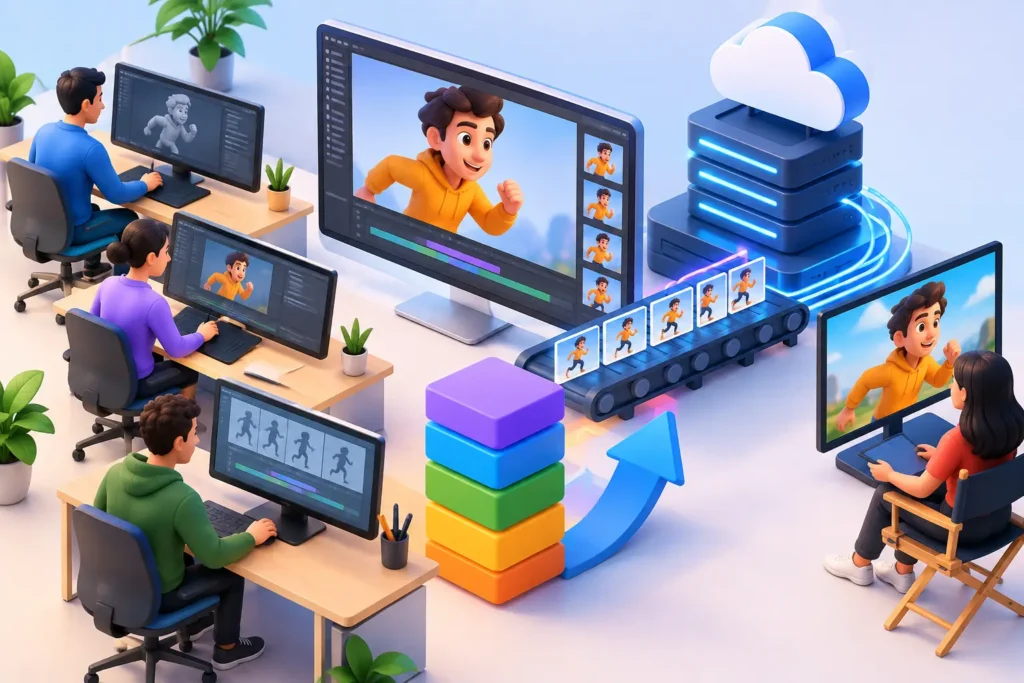

A strong animation can still miss the mark if the final frames feel flat, inconsistent, or unfinished. That is exactly where 3d animation post production services make the difference. They turn rendered sequences into client-ready visual assets that look cohesive, communicate clearly, and hold up across marketing, broadcast, product, and film use.
For brands, studios, and production teams, post-production is not a cosmetic add-on. It is the stage where pacing is corrected, materials are balanced, effects are integrated, and the full piece is prepared for its real-world environment. If your internal team is already stretched, outsourcing this phase can remove a major production bottleneck without sacrificing quality control.
What 3D animation post production services include
Post-production starts after animation and rendering, but it is closely tied to every creative and technical choice that came before it. In practical terms, 3d animation post production services often include compositing, color correction, lighting enhancement, visual effects integration, camera refinement, motion graphics support, editing, sound sync preparation, and final output formatting.
Compositing is one of the most valuable parts of the process. Separate render passes such as diffuse, shadow, reflection, ambient occlusion, Z-depth, and specular can be combined and adjusted with much more control than a single baked render. That flexibility matters when a client wants cleaner highlights on a product shot, softer atmospheric depth in an architectural flythrough, or a more cinematic mood in a branded animation.
Editing also plays a bigger role than many buyers expect. Even a beautifully animated sequence can lose impact if the rhythm is off. Post-production teams shape timing, transitions, shot order, and emphasis so the message lands clearly. For commercial work, that often means protecting attention in the first few seconds. For technical or medical animation, it may mean slowing key moments so complex information remains understandable.
Why outsourced post-production makes business sense
Many companies can handle part of the 3D pipeline internally, but post-production tends to expose gaps in bandwidth and specialization. Teams may be strong in modeling and animation but less equipped for compositing-heavy finishing work, delivery prep, or fast revision cycles across multiple formats.
Outsourcing solves a capacity problem, but the real value is operational. An experienced external team already has the tools, workflow discipline, and technical oversight to move assets through final polish efficiently. That reduces delays caused by handoffs between freelancers, scattered file management, or inconsistent finishing standards.
This model also helps when project demand is uneven. A product company may need a short burst of intensive post work before a launch. A studio may need overflow support during peak production. An architecture firm may only require finishing services for selected presentations rather than every visualization. In each case, outsourced support lets decision-makers scale output without adding full-time headcount.
Where quality is won or lost in post-production
The difference between average and high-performing post-production is rarely one dramatic effect. It is usually the accumulation of precise choices. Exposure levels need to be controlled so no shot feels disconnected from the next. Reflections need to feel deliberate rather than distracting. Depth cues should support realism, not muddy the frame. Motion blur, bloom, lens effects, and atmospheric treatment all need restraint.
That is especially true in commercial work. Product animation must present materials accurately while still looking premium. Medical animation must stay clear and credible, which means stylization has limits. Architectural animation needs a balance between mood and factual representation. Film and TV content may tolerate more stylized grading or effects, but continuity becomes much more demanding.
A capable production partner knows when to push visual impact and when to protect clarity. That judgment matters just as much as software skill.
3D animation post production services for different industries
Not every project needs the same finishing approach, and that is where specialized experience matters. 3d animation post production services should be tailored to the commercial purpose of the asset, not applied as a one-size-fits-all package.
Product marketing and e-commerce
For product brands, post-production is often about control. Surfaces must look intentional. Labels, finishes, and details need to remain accurate. The final animation has to work across campaign cuts, social placements, launch videos, and sales presentations. Here, post teams focus on polish, consistency, and conversion-friendly presentation.
Film, TV, and entertainment
In entertainment workflows, post-production often becomes more layered. Compositing, shot matching, cinematic grading, and effects integration all carry more creative weight. Revision volume can also be higher because final output must fit broader editorial and narrative demands.
Architecture and real estate
Architectural visuals need atmosphere, but they also need trust. Buyers, developers, and stakeholders want imagery that feels aspirational without becoming misleading. Post-production helps sharpen lighting, environmental realism, and spatial readability while keeping the design intent intact.
Medical and technical animation
This category leaves less room for purely aesthetic decisions. Accuracy, readability, and sequence clarity come first. Post-production supports viewer understanding by emphasizing key actions, refining visual hierarchy, and reducing noise that could distract from the subject matter.
What to look for in a post-production partner
The best outsourcing partner is not simply the cheapest vendor who can add effects to renders. You need a team that understands the full production chain and can work backward from the final deliverable to make smart finishing decisions.
Look for process transparency. That includes clear revision rounds, file handoff standards, version control, and delivery specs. Ask how the team handles render passes, color consistency, frame rate requirements, and format outputs for different channels. If those answers are vague, the project will likely become slower and more expensive once revisions start.
It also helps to assess whether the partner can support adjacent services. Post-production rarely lives in isolation. A client may need extra scene cleanup, re-rendering, environment updates, rig fixes, or editorial adjustments during finishing. A full-service production company can address those issues without forcing you to coordinate multiple vendors under deadline pressure.
This is where an experienced outsourced team such as 3D Modeling Animation Studio can offer a clear advantage. When modeling, animation, and post-production support exist under one production framework, approvals move faster and technical issues are resolved earlier.
Common trade-offs clients should understand
Faster turnaround is possible, but it depends on asset quality upstream. If animation files arrive disorganized or render passes are incomplete, post-production becomes partly a rescue job. That increases time and can limit how much refinement is realistically achievable.
Budget is another variable. A lean post-production package may be enough for a straightforward explainer or product loop. A high-end campaign piece with multiple outputs, advanced compositing, and brand-specific finishing standards will require more time and more review checkpoints. Spending less upfront can work if the scope is simple. It usually backfires when expectations are cinematic but the finishing budget is minimal.
There is also a creative trade-off between realism and style. Some brands want pristine, physically accurate imagery. Others want heightened contrast, mood, or dramatic visual treatment. Neither is inherently better, but the target audience and use case should guide the finishing choices.
How the workflow should feel from a client perspective
A good post-production process should reduce uncertainty, not add to it. Clients should know what stage the project is in, what approvals are needed, what revisions are included, and what deliverables will be supplied at the end.
Most successful workflows begin with a clear review of rendered assets, project goals, and destination formats. From there, the team develops a finishing plan that covers compositing, edit structure, color direction, effects treatment, and output requirements. Review checkpoints are then placed where they save time, usually before polishing every shot to completion.
That structure matters because endless revisions are rarely a sign of high standards. More often, they signal unclear direction at the start. A disciplined partner keeps creative goals visible while protecting schedule and budget.
Final output is where value becomes visible
Post-production is the stage clients notice most, even if they do not always label it that way. It affects whether a product looks premium, whether an environment feels believable, whether a technical sequence is easy to follow, and whether the final asset is usable across channels without last-minute fixes.
If you are investing in 3D content for sales, marketing, entertainment, architecture, or specialized communication, the finishing stage deserves the same attention as modeling and animation. The right post-production team does more than clean up renders. It strengthens the business result behind every frame.
When deadlines are tight and expectations are high, that kind of support is not extra. It is what gets the project over the line with confidence.