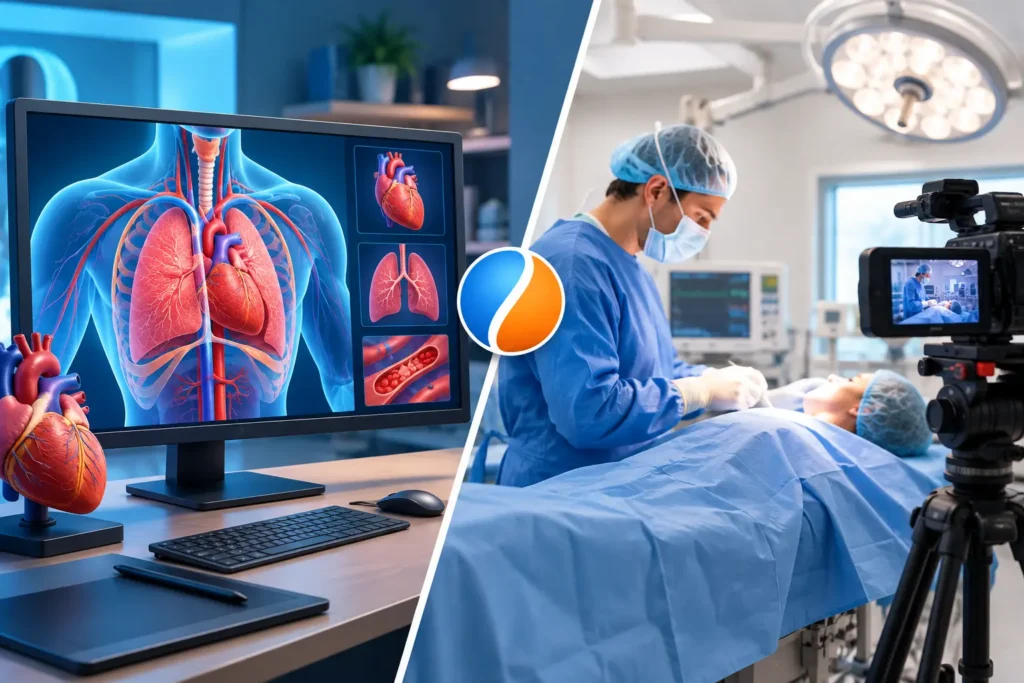
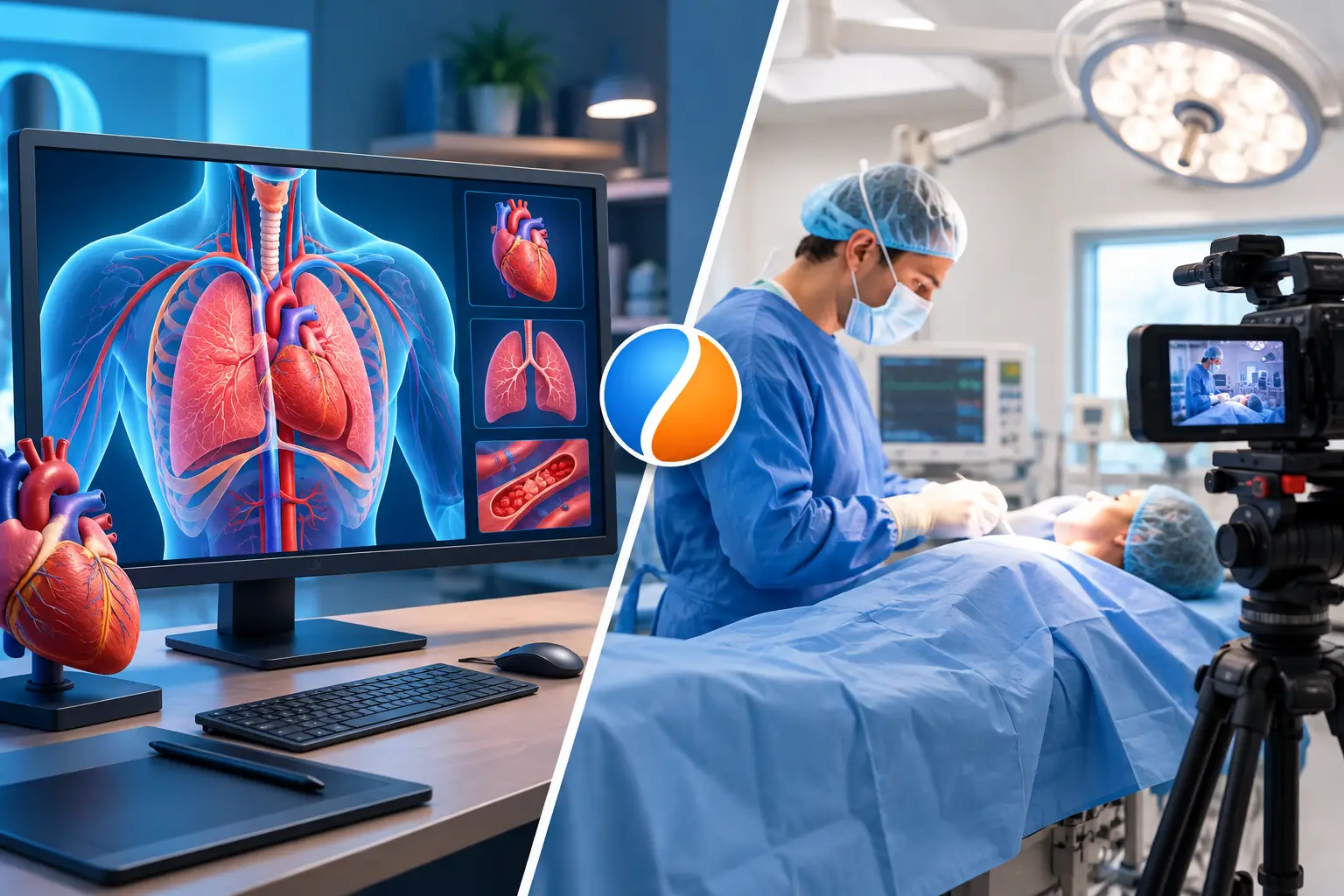
A surgeon explaining a new implant, a patient considering a treatment, and a sales team presenting to a hospital committee do not need the same kind of video. That is why the medical animation vs live action decision should begin with the communication goal, not a default production preference. Both formats can build credibility and explain complex subjects, but they do so through very different strengths.
For healthcare brands, device manufacturers, pharmaceutical companies, and training providers, the right choice affects comprehension, production timelines, compliance review, and campaign performance. The best production approach is the one that makes the message clear without adding avoidable cost or complexity.
Medical Animation vs Live Action: The Core Difference
Medical animation uses designed 2D or 3D visuals to show anatomy, physiology, treatment pathways, device mechanics, and molecular processes. It can move inside the body, isolate a structure, remove visual distractions, and show events that cannot be filmed safely or practically.
Live action uses real people, environments, products, and demonstrations. It is particularly effective when the audience needs to see a clinician, patient, facility, or product team in a believable real-world setting. A live-action video can establish human connection quickly because viewers recognize faces, emotions, and familiar clinical interactions.
Neither option is automatically better. Medical animation is usually the stronger choice for explaining what cannot be seen. Live action is often more persuasive when trust depends on real people and real context. Many high-performing healthcare campaigns use both, with each format assigned a clear job.
When Medical Animation Is the Best Choice
Medical subjects often involve processes that are invisible, microscopic, internal, or too sensitive to film. Animation gives a production team complete control over the image, making it possible to simplify a complex mechanism without compromising technical accuracy.
A 3D animation can show how a stent expands inside an artery, how a robotic surgical system moves through a procedure, or how a therapy interacts with a specific receptor. The camera can travel through anatomy, pause at a critical stage, and show a cutaway view that would be impossible in conventional footage. This level of visual control is valuable in physician education, investor presentations, medical device marketing, and patient education.
Animation also supports consistency. A product can be shown in a polished, controlled environment every time, regardless of product availability, facility access, lighting conditions, or clinical scheduling. Once a 3D asset is built, it can be adapted for new camera angles, regional markets, presentations, social content, and future product updates. That reuse can improve the long-term value of a visual production investment.
There is also a practical compliance advantage. Filming procedures involving patients may require consent, privacy protections, institutional approvals, and careful review of every detail in the frame. Animation can reduce those production barriers while still presenting a scientifically accurate scenario. It does not remove the need for medical, legal, and regulatory review, but it gives reviewers a cleaner and more controllable visual environment.
The trade-off is that medical animation requires specialized skill. Anatomy, device geometry, motion, lighting, and terminology must all be handled with precision. A visually impressive animation that misrepresents a mechanism of action can create serious credibility and compliance problems. The right partner needs both strong 3D production capability and a disciplined approval workflow that keeps subject matter experts involved at the right stages.
Animation is especially effective for
Medical animation performs best when the message depends on showing internal anatomy, mechanisms of action, surgical workflows, molecular activity, product assembly, or a before-and-after treatment effect. It is also a strong option when a brand needs a premium, repeatable visual asset library rather than a single campaign video.
When Live Action Delivers More Value
Live action is powerful because it puts a human face on a clinical or technical message. A physician describing why they use a device can feel more credible than an abstract explanation alone. A patient discussing a treatment journey can make an educational campaign more relatable. A real lab, hospital, or manufacturing facility can reinforce operational credibility.
For recruitment, brand storytelling, clinical training, testimonials, and executive messaging, live action often creates the emotional connection that animation cannot fully replicate. It captures body language, bedside interaction, and the practical context around care delivery. These details matter when an audience is evaluating not just what a company offers, but whether it understands the people affected by it.
Live action can also be efficient for simple messages. If a clinician needs to demonstrate how to prepare a device or explain a straightforward workflow, filming the actual steps may be faster than building detailed 3D models and animation from scratch. This is particularly true when the product, location, and participants are already available.
However, live action brings operational constraints. Scheduling clinicians, securing locations, managing crew access, protecting patient privacy, and controlling sound and lighting can extend the production timeline. Reshoots may be expensive, especially if a facility or spokesperson has limited availability. The camera can only show what is physically available and safe to capture.
Live action also has limits when a concept needs visual simplification. A filmed operating room can be informative, but it may contain clutter, obstructed views, and details that distract from the core teaching point. It cannot easily show what happens beneath the skin or inside a device. In these situations, animation is not a replacement for reality. It is a clearer way to communicate the part of reality the camera cannot reach.
Comparing Cost, Timeline, and Flexibility
Budget comparisons are rarely as simple as animation costs more or live action costs less. A basic live-action shoot can be cost-effective, but the total expense rises when it requires travel, location fees, specialized crews, talent, clinical access, multiple shoot days, and extensive compliance management. A sophisticated 3D medical animation may require a larger upfront investment because of modeling, rigging, look development, and review cycles.
The more useful question is whether the asset will have a long working life. Animation can be revised without reassembling a physical production. If a medical device changes, a team can update the affected 3D model, labels, or sequences. With live action, a product redesign may require another shoot, new equipment preparation, and renewed participant coordination.
Timelines depend on the project scope. A tightly planned live-action video can move quickly when access is easy and approvals are clear. A short animation may also be efficient when existing 3D assets are available. For complex projects, the most reliable path is a defined pre-production phase that confirms the audience, script, visual style, claims, review owners, and delivery requirements before production begins.
The Strongest Option Is Often a Hybrid
A hybrid video can combine the credibility of live action with the explanatory power of 3D visualization. For example, a physician may introduce a clinical challenge on camera, followed by a medical animation that shows the device mechanism. The video can then return to the physician for practical implications, training guidance, or a call to action.
This format works especially well for product launches and sales enablement. Real experts establish authority, while animation removes ambiguity around the product’s technical value. It also creates a flexible content package: interview clips for social media, animation segments for trade shows, and a full-length video for presentations or websites.
A hybrid approach does require careful planning. The visual transition between footage and animation must feel intentional, and the script should avoid repeating the same information in both formats. Each scene should earn its place by doing something the other format cannot do as well.
How to Choose the Right Production Format
Start by identifying the single hardest idea your audience must understand. If that idea involves internal processes, tiny components, hidden anatomy, or precise movement, animation should lead the production. If the message depends on empathy, leadership, patient experience, or a real clinical setting, live action should take a larger role.
Consider these project questions before requesting a production quote:
- Does the audience need to see an invisible process or a real person?
- Will the asset need frequent updates, new language versions, or multiple format adaptations?
- Are there privacy, consent, or facility-access risks that could delay filming?
- Is the objective education, brand trust, sales conversion, clinical training, or a combination of these goals?
- Do you have approved product files, medical references, and subject matter experts available for review?
The answers create a clearer production plan and help prevent a common mistake: choosing a format because it looks familiar rather than because it serves the message. An expert outsourced team can also assess whether existing CAD files, product footage, or brand assets can reduce production time and protect the budget.
For organizations balancing technical accuracy with demanding launch schedules, 3D Modeling Animation Studio provides the specialized production capacity to plan, build, animate, edit, and deliver medical visuals without requiring a larger in-house team. The objective is not simply to produce a polished video. It is to create an asset that gives decision-makers, clinicians, and patients the confidence to understand what matters.
The next time a medical message feels difficult to explain, do not ask whether animation or live action is more impressive. Ask what your audience needs to see, believe, and do after the video ends. That answer will point the production in the right direction.