A product launch is six weeks away. Your internal team has the core concept, but it lacks the capacity to model every variation, create polished animation, render final shots, and manage revisions without putting other work at risk. A global animation production partner gives you a practical way to close that gap: specialized production capacity that can expand when the project demands it and contract when it does not.
For brands, studios, architects, and production companies, outsourcing animation is not simply a cost decision. The right partner becomes an extension of your production operation. They need to understand creative direction, technical requirements, approval structures, and the commercial purpose behind every asset.
What a Global Animation Production Partner Should Deliver
A capable production partner does more than accept files and return renders. They provide a coordinated workflow that turns a brief into production-ready visuals, whether the deliverables include product animation, character work, architectural visualization, medical animation, environments, or post-production.
The strongest outsourcing relationships start with clear scope definition. Before modeling or animation begins, the production team should confirm the intended audience, final platforms, aspect ratios, animation duration, brand standards, source assets, and review milestones. This early alignment prevents a common problem in outsourced work: discovering late in the process that a visually strong asset does not meet the requirements of a campaign, broadcast delivery, sales presentation, or product configurator.
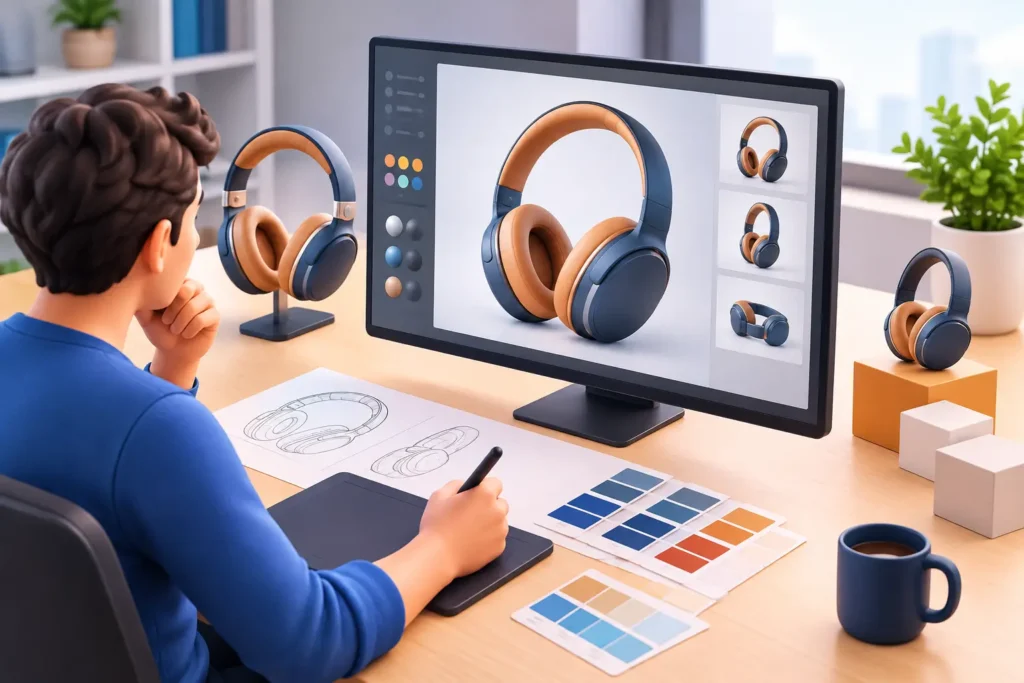
Technical precision matters just as much as artistic quality. A consumer product animation may need accurate materials, manufacturing details, and branded color values. A medical animation may require scientifically credible anatomy and a review process that respects subject-matter expertise. An architectural rendering needs the correct proportions, lighting intent, finishes, and environmental context. The partner should adapt its process to the application rather than applying the same visual formula to every assignment.
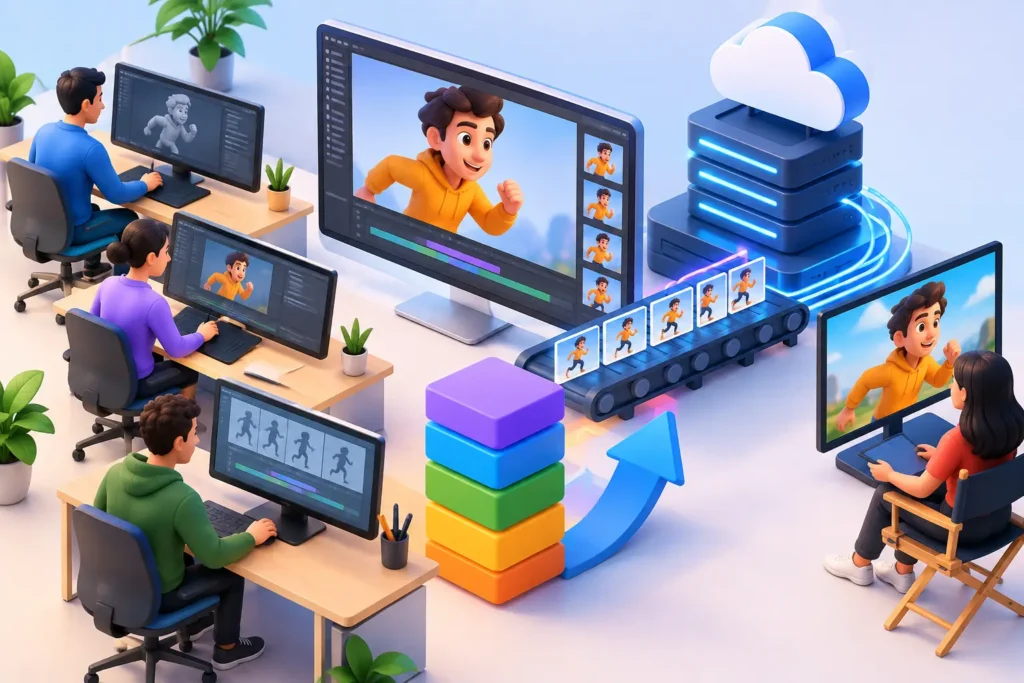
A global team also gives clients access to a broader range of specialized skills. One project may require hard-surface modelers, while another needs riggers, lighting artists, motion designers, compositors, and video editors. Building all of that capacity internally is expensive and rarely efficient for organizations with changing project volumes. Outsourced production support lets companies assemble the right skill mix for the work in front of them.
Why Global Production Capacity Matters
Global capability is valuable when it improves delivery, not when it creates more coordination work. The advantage comes from having a team structured to support projects across locations, schedules, and production stages.
Time-zone coverage can shorten the time between review cycles. A client team can provide feedback at the end of its business day, and the production team can prepare updated files for the next morning. That does not mean every project should be rushed. High-end animation still requires adequate time for concept development, modeling, texturing, animation, lighting, rendering, and quality control. But a well-managed global workflow reduces avoidable idle time between these steps.
Scalability is often the more significant benefit. Marketing demand is rarely steady. A company may need a single hero product video one month, then a large set of localized assets, product variants, social edits, and sales visuals the next. A production partner can add artists and production management without forcing the client to recruit, onboard, and retain a larger in-house team for a temporary workload spike.
This model is especially useful for animation studios and production houses. When internal artists are committed to a flagship project, external capacity can handle defined work packages such as environment modeling, asset cleanup, rigging, secondary animation, rendering, compositing, or final video editing. The client retains creative control while gaining reliable execution support.
There are trade-offs. A global arrangement requires disciplined communication, well-organized source files, and decision-makers who can provide timely feedback. It is not the best choice when a project has an undefined concept, no available reference material, and daily creative changes with no approval owner. In those situations, the first priority should be clarifying the brief and establishing a realistic review structure.
Evaluate the Production Process, Not Just the Portfolio
A portfolio can show that a studio produces attractive work. It does not necessarily show whether the studio can manage your project reliably. Business buyers should assess the operational side of the relationship with the same care they give visual samples.
Start with discovery and estimation. A dependable partner asks practical questions before quoting: What files are available? Are CAD models usable for production? Which details must be accurate? What is the delivery format? How many review rounds are expected? Are there multiple language versions or product variants? These questions are not delays. They are how a team protects the schedule and avoids change orders caused by unclear assumptions.
Next, look at milestone planning. A professional workflow normally separates major approvals into stages such as style frames or animatics, low-poly or blockout modeling, final modeling and texturing, animation, lighting, and final compositing. The exact stages vary by project, but the principle is consistent: resolve major creative and technical decisions before the most expensive production work is complete.
File handling is another deciding factor. For product companies and manufacturers, proprietary CAD data, prototypes, and unreleased product information may require controlled access and clear confidentiality procedures. For studios, organized naming conventions, version control, approved asset libraries, and delivery specifications help external teams integrate into an existing pipeline. Ask how the partner receives, stores, tracks, and returns project files.
Finally, examine quality control. Rendering a shot is not the same as finishing it. Quality assurance should check modeling accuracy, texture consistency, animation timing, lighting, camera continuity, brand compliance, and final export settings. If a project includes a series of product variants or multiple deliverable formats, this review becomes even more important. Small inconsistencies can weaken the credibility of an otherwise strong campaign.
Build a Better Brief for Better Animation
Clients do not need to arrive with a complete production bible, but the quality of the input affects the speed and accuracy of the output. The most productive briefs connect creative direction to business outcomes.
Rather than asking for a “premium-looking” product video, explain what premium means for the brand. Is the goal to emphasize material craftsmanship, demonstrate a complex function, simplify a technical benefit, or create a dramatic launch moment? Reference imagery is useful, but it should be paired with direction about what to take from each example: camera movement, lighting mood, pacing, composition, material treatment, or storytelling structure.
Provide the best available source assets early. These may include CAD files, engineering drawings, product photography, brand guidelines, logos, packaging artwork, floor plans, architectural drawings, scripts, voiceover, and product claims that need exact wording. If assets are incomplete, say so at the beginning. An experienced team can recommend what to build, approximate, or source, but that choice may affect cost, timing, and visual accuracy.
It also helps to identify one person or a small group with approval authority. Too many uncoordinated reviewers can turn minor adjustments into conflicting direction. A global animation production partner should make reviews easy to manage, but the client needs a clear internal decision process as well.
Match the Partnership Model to the Project
Not every project needs the same level of support. A one-time architectural flythrough may work well as a fixed-scope assignment with defined deliverables and approval rounds. A product company launching frequent updates may benefit more from an ongoing production arrangement where the team learns the product line, brand standards, and preferred visual style over time.
Long-term collaboration reduces repeated onboarding. The production team becomes familiar with approved materials, camera preferences, color standards, technical terminology, and review expectations. That familiarity can improve speed and consistency, particularly when content must be produced across several product lines or markets.
For high-visibility work, consider starting with a pilot project. A short product animation, a small set of rendered images, or a single environment can reveal how the team communicates, interprets feedback, and manages technical requirements. The goal is not to test a partner with an artificially difficult assignment. It is to establish whether their process supports the way your organization actually works.
Cost should be evaluated against the complete production picture. The lowest quote may exclude revision capacity, project management, post-production, source-file preparation, or the level of detail required for close-up shots. A higher quote can be the better business choice if it reflects accurate scoping, experienced specialists, and a quality-control process that prevents expensive rework later.
The right external team does not replace your creative direction or business expertise. It gives that expertise the production capacity to reach the market on time, with visuals that are technically credible, commercially focused, and ready to perform where your audience sees them.